Steel vs Composite: Rethinking Strength Members for Fiber Networks
Steel vs Composite
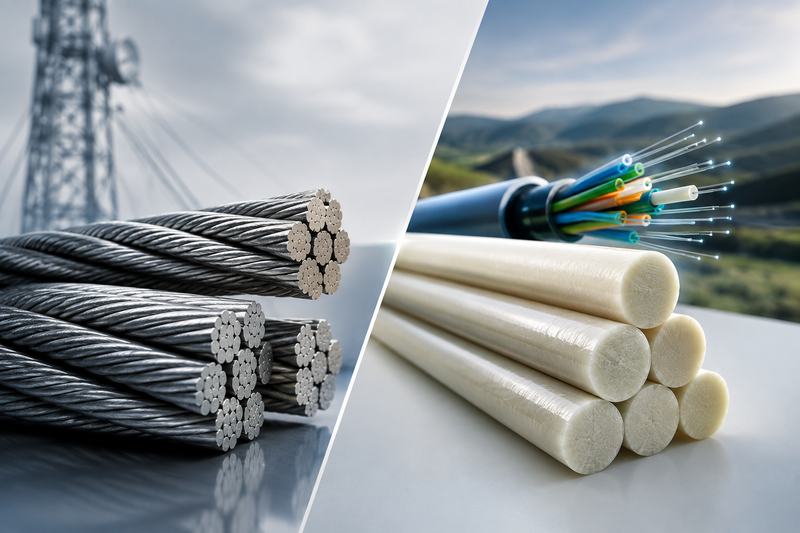

When telecom operators design a fiber optic cable, most of the engineering conversation revolves around the glass fibers themselves, attenuation, bandwidth, core diameter. But buried at the center of every cable is a component that decides whether that fiber survives installation and decades of environmental stress: the strength member. For years, steel wire held this role by default. Today, that default is being questioned.
Modern cable manufacturers are increasingly turning to composite reinforcement rods instead of steel, and the shift isn't cosmetic. It reflects a fundamental rethink of what a strength member needs to do in an all-dielectric cable environment, carry mechanical load without introducing electrical risk, weight, or long-term degradation.
The Case Steel Used to Make
Steel wire was the obvious first choice for cable reinforcement decades ago, and it's easy to see why. It was cheap, widely available, and mechanically strong in tension. For copper telecom cables and early fiber deployments, that was often enough.
But fiber optic networks introduced a new set of demands that steel was never designed to meet. As networks expanded near power infrastructure, railway corridors, and lightning-prone regions, the fact that steel conducts electricity stopped being a minor footnote and became a genuine safety and interference concern. Add to that steel's vulnerability to rust in humid or underground environments, and its advantages start to look a lot thinner over a 20-30 year cable service life.
Where Composite Rods Take Over
A pultruded glass-reinforced rod solves the core problems steel introduces, while matching or exceeding it on raw strength.
No electrical conductivity. This is the single biggest reason composite rods dominate all-dielectric cable design today. A rod that carries zero electrical charge means cables can be strung alongside power lines, buried near electrical conduits, or deployed in lightning-heavy regions without the grounding requirements steel would demand.
No rust, no degradation. Steel's Achilles heel is corrosion. Composite rods are chemically inert to moisture and most environmental exposure, meaning the strength member installed today performs the same 15 years from now, whether it's sitting in a coastal duct or an underground vault.
Better strength-to-weight ratio. Ounce for ounce, a well-engineered composite rod delivers tensile strength on par with steel at roughly a quarter of the weight. For installation crews pulling cable through miles of duct, that weight difference adds up fast — less strain, faster deployment, lower equipment wear.
Thermal stability. Steel and glass composites respond differently to temperature swings. Composite rods are engineered with coefficients of thermal expansion that closely track the glass fibers they protect, minimizing the micro-bending that causes signal loss when temperatures fluctuate.
What This Means for Cable Engineers
If you're specifying a strength member for a new cable design or evaluating a supplier switch, the comparison usually comes down to a handful of measurable factors:
Tensile strength per unit weight — composite rods typically win this comparison outright.
Dielectric performance — a non-negotiable requirement for all-dielectric cable classifications.
Corrosion resistance over service life — steel requires protective coatings that composite rods don't need.
Splice-free run length — longer continuous rod lengths mean fewer joints and fewer potential failure points across a production batch.
Buckling resistance during installation — the rod has to hold its shape under compressive and tensile stress simultaneously, especially during pulling and coiling.
None of this means steel disappears entirely — some hybrid and armored cable designs still use it for specific mechanical roles. But for standard all-dielectric fiber cable, the case for composite reinforcement has become difficult to argue against on technical grounds alone.
A Practical Shift, Not Just a Trend
It's worth noting that this isn't a recent fad chasing sustainability optics. The move toward composite strength members has been building steadily as telecom networks push into denser urban builds, longer rural runs, and hybrid power-fiber cable designs where dielectric separation isn't optional. Manufacturers who standardized on composite rods years ago are now seeing the payoff in lower field failure rates and easier long-term maintenance.
Final Thoughts
Choosing a strength member might seem like a small line item in an overall cable bill of materials, but it has an outsized effect on how that cable performs over its entire service life. As fiber networks continue expanding into more demanding environments, the shift away from steel and toward engineered composite rods looks less like an alternative and more like the new baseline for reliable, future-ready cable design.

Comments
No comments yet. Be the first to comment!